① Project Background
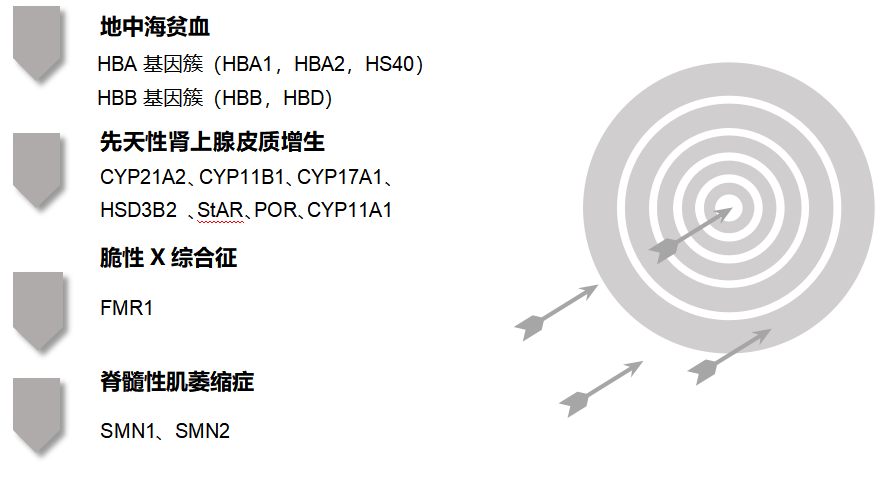
Thalassemia is a hereditary chronic hemolytic disease caused by the absence or mutation of the genetic material that leads to the synthesis disorder or reduction of the rate of the globin chains of hemoglobin, resulting in a decrease in the production of hemoglobin. It is also known as globin synthesis disorders anemia. Thalassemia is one of the most common single-gene hereditary diseases in China, with the highest incidence and the greatest impact in the provinces south of the Yangtze River. It is also a local birth defect disease that seriously affects children's health and the birth population, bringing a heavy burden of spirit and economy to families and society.
Congenital Adrenal Hyperplasia (CAH) is a group of autosomal recessive genetic diseases caused by defects in various catalytic enzymes in the adrenal corticosteroid biosynthetic pathway, leading to disorders in corticosteroid synthesis. The severity and clinical features of CAH depend on the residual activity of the enzyme, which can be life-threatening in severe cases. The clinical phenotype of typical and atypical CAH patients also includes a series of clinical conditions such as adrenal insufficiency, ambiguous or incomplete sexual development, infertility, short stature, and an increased risk of metabolic syndrome during adolescence and adulthood.
Fragile X Syndrome (FXS) is the most common single-gene cause of genetic intellectual disability and autism spectrum disorder (ASD), second only to Down syndrome in incidence. Over 99% of cases are caused by a CGG repeat expansion and abnormal methylation of the fragile X messenger ribonucleic acid 1 gene (FMR1) on the X chromosome, resulting in the absence of the encoded protein FMRP, while the rest are caused by point mutations or deletion mutations in FMR1, which are inherited in an X-linked incomplete dominant manner.
Spinal Muscular Atrophy (SMA) is a genetic neuromuscular disease caused by the degeneration of spinal motor neurons, leading to muscle atrophy and generalized muscle wasting, and is one of the most common causes of infant mortality due to autosomal recessive inheritance. The disease is mainly caused by a pathogenic genetic mutation in the survival of motor neuron gene 1 (SMN1). Normal individuals have two copies of SMN1, and when there is a homozygous deletion of the 7th exon of the SMN1 gene or a compound heterozygous mutation in the SMN1 gene, it can be diagnosed as SMA. The disease-causing gene SMN1 and the modifying gene SMN2 are highly homologous and can express about 10% of the full-length SMN protein with normal function. The SMN2 gene has a compensatory effect on the deletion of the SMN1 gene.
② Project Introduction
Nanopore sequencing has comprehensive technical advantages, such as ultra-long read length, no GC preference, and accurate sequencing of complex regions such as highly repetitive regions. By using probe capture and multiple long fragment amplification methods, the relevant pathogenic genes and regions are captured and sequenced, combined with the third-generation Nanopore single molecule real-time sequencing platform, to truly achieve comprehensive gene testing of complex monogenic genetic disease-related genes.
In contrast, traditional methods have many disadvantages. For example, in thalassemia detection, conventional PCR can only cover 23 loci, and the detection range is limited; and the short read length of second-generation sequencing makes it limited for detecting triplet and Hong Kong type, large segment deletion; in congenital adrenal hyperplasia detection, traditional detection methods can only detect CYP21A2, can not distinguish other types of CAH, and the clinical requirements are high; there is a possibility of false negative in gene copy number repeat and deletion detection.
③ Scope of detection
④ Project advantages
Wide detection range: The target genes are covered in one go, and it is possible to discover novel structural variants or point mutation types;
Precise typing: It can accurately identify homologous genes, can be independent of family, directly obtain cis/trans gene variants, and obtain accurate alignment methods;
High sensitivity of detection: can detect various types of mutations and "AGG" insertions.
⑤ Applicable people
Carrier screening for premarital, preconception, and prenatal populations to assess reproductive risk, and prenatal diagnosis for high-risk fetuses to reduce the incidence of severe birth defects.
By carrying screening of common monogenic diseases, PGT-M testing is performed for high-risk couples preparing for third-generation IVF to have healthy children.
Screening for common monogenic diseases in newborns, early detection, early intervention and early treatment, to reduce the mortality and morbidity of affected children and improve the quality of life.
Genetic diagnosis of patients or differential diagnosis of suspected patients